HOW TO SAFELY HANDLE USED NEEDLES AND TUBES AFTER
USE was a good question!
...and at the time - 1990 - state of the art thinking by
UNIMAXFor safety
reprocessing tools, it was obvious that a better method was needed than
current practices requiring the cleaning of contaminated equipment that
potentially cross-contaminated the facilities and personnel.
I reasoned that we could sterilize first and then clean and
re-sterilize? After 12 years of consideration and field
application (from 1990) a "Unimax System" was practical (being practiced in
our 2 tattoo shops in NYC: Sacred Tattoo and Bowery Tattoo) and a feasible
though more expensive way to meet OSHA requirements for the safe handling
of contaminated tools in Tattoo and Piercing. Further, it seemed
it would support the
spirit and principles of OSHA to adopt a safer system.
An alternative was using a completely
disposable tube grip and needle assembly
However, to require the adoption of
completely disposable tube, grip and needle
(it did not exist)
would not be acceptable to the many tattooists who tattoo better with the weight
of Stainless Steel.
A mandatory disposable system would not be appropriate because
(A) re-usable (Stainless Steel) tools are currently invested in and usable, and
(B) a safe method for handling reusable tubes The Unimax System culd be
adopted
|
Unimax System may be an interesting
alternative.
Any comments or improvements or flaws in this system, are asked to
please write to, Wes Wood at info@unimaxsupply.com
Current practices seem\ed to
- violate OSHA proper work practices for the safe handling of contaminated
equipment,
- violate OSHA safe disposal of liquid wastes,
- violate OSHA 1910.1030(d)(3)(x)
worker personal protective equipment standards while cleaning contaminated items,
- violate OSHA proper work practices transporting contaminated equipment and
- violate OSHA requirements to adherence to OSHA standards.
Reminder: Tattoo and piercing are required to follow local, state and federal regulations.
Following the procedure below does not violate OSHA 1910.1030
We suggest for your study the following
procedure
which we believe enhances worker protection by applying the
spirit and principles of OSHA
1910.1030.
|
The UNIMAX SYSTEM at a glance.
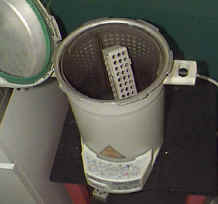
An autoclave at each station. Rinse, place directly into autoclave
and run a cycle.
After sterilization, processes normally, cleaning, bagging,
sterilizing etc.. |
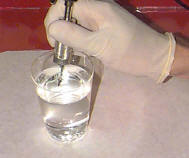
| 1. Rinse out the tube, or wipe the
piercing tool when finished. |
For tattooing,
This is the only "pain in the neck part" you should rinse out
the tube after finishing the job.
Run your needle and
tube in your cleaning cup just like changing colors.
Piercing tools can be easily wiped with an antimicrobial cloth wipe.
Reduce the starting microbial load. If you
don't remove the excess ink now it will be harder to remove after
sterilization.
This is the step that adequately satisfies OSHA "pre-cleaning"
to reduce the starting microbial load -- but without spreading
potentially contaminating microbes. This step demonstrates that limiting microbial contamination
to a cup of water is safer that spreading it around
a shop to a sink, an ultrasonic and surrounding areas.
"Rinsing-cup" liquid and liquids from ultrasonics* can be disposed of as follows:
add 10% bleach and let sit for 10-15 minutes.
Pour into the sanitary sewage system via the toilet (not the sink)
taking care to avoid splashing.
Dumping "untreated" contaminated water into the sanitary waste
system is a violation of safe handling of contaminated
wastes.
Piercing tools can be wiped with a disinfectant cloth immediately
after the procedure to remove any visible ointment or body fluids
and placed directly in the basket or in the tray in front loaders.
|
 |
|
| 2. Place unit or tube in container or sterilizer
tray and sterilize |
Dismount the needle-tube-grip unit from the tattoo
machine and
lift the needle up and out of the tube by the loop and place it
into a Sharps Container.
It would be contrary to safe handling to turn the tube
upside down and hope the needle drops or can be shaken out into a
sharps container as suggested by some. Beside being upside down with
the needle portion up this suggestion is laughable.
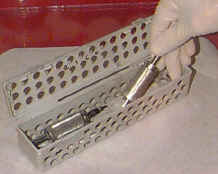
Place the tube with grip directly into an autoclavable
container or directly into the autoclave tray inside the
sterilizer. Autoclave at end of day or as convenient or
necessary as the work schedule permits.
A small autoclave within each station sis needed.
Used instruments are never to be left in an open exposed state after
the work is completed nor should contaminated tools be kept in
disinfecting trays or temporary holding containers.
It would be a violation to transport or carry a "pan" or
tray of
contaminated liquid with tools from the station to a separate room
for cleaning. Contaminated liquids can only be transported in leak-proof tightly-closed
containers. 3. After sterilization
processes normally, cleaning, bagging, sterilizing etc..
All tools are now sterile after initial sterilization,
potential contamination has been eliminated.
It is possible to sterilize without the tools being completely
100% clean.
Tools may now be brushed clean without fear of contamination or spatter.
Dry, package and sterilize in sealed autoclave bags as normal.
It would be a violation of safety principles to
brush-clean contaminated equipment
not wearing face
protection, not using heavy-duty protective gloves (as opposed to latex
gloves)
and without impervious body covering.
For example, it would be prohibited to clean using street
clothes as protection
or an apron (that would not protect the arms).
To clean contaminated equipment protective clothing must be worn
that has been
specifically made to protect the worker from contamination. |
 |
 |
| |
|
Cleaning
contaminated tools is not
a reasonable activity for a retail shop.
The room itself would be prohibitive to construct to meet
standards of safety. |
It is
an OSHA violation of safe handling to bend, break, melt, recap, remove
or do anything
to contaminated sharps except dispose of them in a sharps container.
There is no other option. Nor are they to be given away to clients.
Anyone reprocessing to save any part of the needle bar is in
violation. |
A benefit,
The Unimax System will save money that is currently spend in decontaminating,
what does not need to become contaminated in the first place.
Better for the environment and better for us as workers.
EVEN A BETTER BENEFIT,
The employee is no longer exposed.
1910.1030(f)(1)(ii)
The employer shall ensure that all medical
evaluations and procedures including the hepatitis B vaccine and vaccination
series and post-exposure evaluation and follow-up, including prophylaxis,
are:
1910.1030(f)(1)(ii)(A)
Made available at no cost to the employee;
1910.1030(f)(1)(ii)(B)
Made available to the employee at a reasonable time and place;
1910.1030(f)(1)(ii)(C)
Performed by or under the supervision of a licensed physician or by or under
the supervision of another licensed healthcare professional; and
1910.1030(f)(1)(ii)(D)
Provided according to recommendations of the U.S. Public Health Service
current at the time these evaluations and procedures take place, except as
specified by this paragraph (f).
*Ultrasonics
|